




Work and Travel USA 2027
What the work involves
During the program you can take seasonal positions, most often in tourism. The work is usually in areas that draw large numbers of visitors over the summer. There are various positions in hotels, restaurants, cafes, shops, amusement parks and national parks, and employers do not require previous experience for them.


How much will I be paid?
average $15-20 / hour
One of the things that matters to each of us when deciding to go on a Work and Travel program, or when choosing a job or employer in the US, is the pay we will be receiving.
The salary for a Work and Travel participant in the US is around $14-$19 per hour for non-tipped positions, and often reaches $20-$22 per hour.
For tipped positions, the base salary is $5-$8 per hour, supplemented by tips – with 15-20% of the total bill being the customary tip in America.
Check out the minimum hourly wage for 2027 in select US states below.
ALASKA
$15
ARIZONA
$15.20
ARKANSAS
$11
CALIFORNIA
$17.40
COLORADO
$15.71
CONNECTICUT
$16.80
WASHINGTON, D.C.
$17.95
DELAWARE
$15
MARYLAND
$15
MASSACHUSETTS
$15
MICHIGAN
$15
MINNESOTA
$11.50
MISSOURI
$15
NEVADA
$12
NEW JERSEY
$15.80
NEW MEXICO
$12
SOUTH DAKOTA
$11.80
VERMONT
$14.80
WASHINGTON
$17.40
WEST VIRGINIA
$8.75
How do I find a job?
You can find a job by choosing from what our American partners offer, or independently, using your own resources and contacts.
VIRTUAL INTERVIEWS
Virtual interviews are an extremely convenient way to secure a job offer in the USA.
Once you have chosen from the offers our American partners provide, a date and time for the interview are set.
It can be held at one of our offices or at your home.
Virtual interviews take place weekly from November to April, over video meeting platforms.
FINDING WORK YOURSELF
This is without doubt the cheapest way to secure a job for next summer.
Friends who were on the programme last summer can be invaluable here, as they can recommend you to their employer.
You can also apply for positions through online platforms for the areas that interest you.
For your safety, the offer goes through checking and verification.
JOB FAIR
Some of the larger employers prefer to travel to Bulgaria to meet in person the students who want to work for them. When choosing an offer you will know in advance whether the interviews are online or in person in Sofia.
Such meetings are usually arranged twice a season – in the first weeks of December and February.
Many students say it is extremely useful and enjoyable to meet their future employer face to face.



What positions can I work?
These are some of the most common Work and Travel USA positions, with a short note on the requirements and what the work involves. You will find a full description of each in the job offer profiles.
WAITER
(server)
✔ excellent English
✔ working with people
✔ a plus: previous experience
✔ tips
Learn more »
This is the position every Work and Travel USA student wants: server.
It is true that you can make good money from tips, but the job has its demands: excellent English, a willingness to work with people, and previous experience is always preferable.
BUSSER
(clearing tables)
✔ helps the servers
✔ intermediate English
✔ tips
Learn more »
However odd it sounds, this job has nothing to do with buses. Bussers are the people who clear the tables once guests have left. They also help the servers.
Intermediate English is usually required. The position comes with tips.
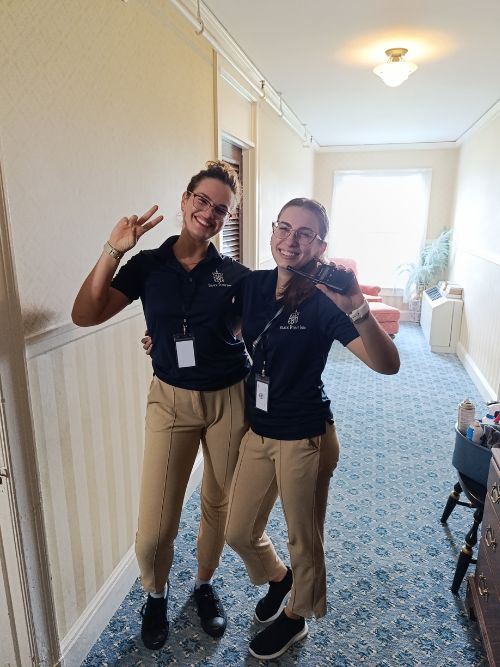
HOUSEKEEPER
(housekeeping)
also known as: houseperson, room attendant, houseman
✔ often includes tips
Learn more »
Also houseperson, room attendant or houseman - all these mean the same thing: housekeeper. The bulk of the work is cleaning and tidying hotel rooms, and sometimes the surrounding areas such as corridors and stairs.
Attention to detail is required. Tips are common.
SALES ASSOCIATE
(shop assistant)
also known as: shop/sales assistant, retail assistant, clerk, retail sales clerk, shop clerk, grocery clerk
Learn more »
There are many names for the “shop assistant” role. This is one of them; others you will come across are shop/sales assistant, retail assistant, clerk, retail sales clerk, shop clerk and grocery clerk.
Duties vary with the goods being sold, but usually include selling various items, talking to customers, restocking shelves and so on.
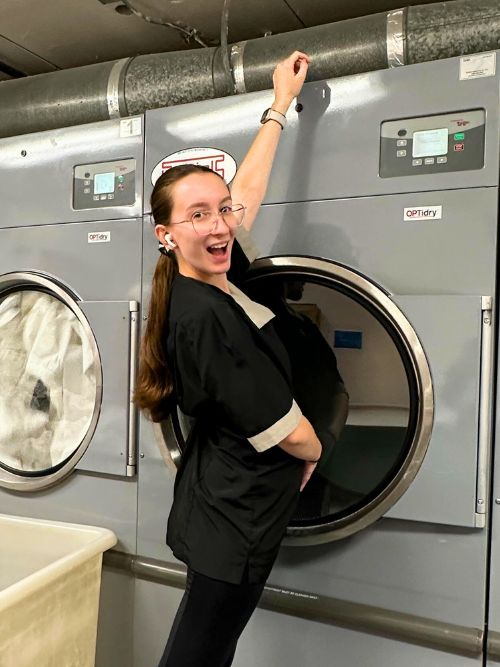
LAUNDRY ATTENDANT
(in the laundry)
✔ basic English
✔ working with washing machines in hotels and restaurants
Learn more »
Definitely one of the best positions for people who are not comfortable speaking English.
It involves working entirely with washing machines in hotels or restaurants - loading, unloading, feeding sheets and towels into the ironing machines and so on.
TRIP HOST PERSON
(coach attendant)
✔ checks tickets, seats passengers, helps
✔ constantly on the move
✔ very good English
Learn more »
These are the people who work on coach services and are something like flight attendants - they check tickets, seat passengers, help out and so on.
If you like your day to pass on four (or rather more) wheels and your English is genuinely good, this is definitely the job for you.
AMUSEMENT PARK ATTENDANT
(at an amusement park)
also known as: game attendant, rides operator
✔ good for large groups of friends
Learn more »
Duties range from selling entry tickets, through operating the rides and looking after visitor safety, to cleaning up at the end of the day.
At most parks, staff are allowed to use the rides free of charge. Parks suit large groups of friends who want to work in the same place.
LIFEGUARD & POOL OPERATOR
(lifeguard)
✔ safety and cleanliness around the water
✔ a compulsory course and certificates
Learn more »
Broadly speaking this is work as a lifeguard: alongside the main duty of ensuring the safety of swimmers, it includes keeping the pool area clean.
Participants work at swimming pools and must have completed a lifeguard course and hold the relevant certificates.
What is your next step?
Fill in the registration form, drop into one of our offices or book an online consultation.
Free consultation in our office
Come to whichever Usit office suits you best and ask a consultant everything you want to know about Work and Travel USA.
Free online consultation
Book a free online consultation with a Usit consultant - held on weekdays at a time that suits you.
Register for the program
Ready for the next step? Secure your place on the program now - the earlier you sign up, the more job choice you have.
FAQ: The student summer work programme in the USA
Some of the questions we are asked most often about Work and Travel USA

Do I need previous experience to be hired?
Absolutely not. Positions on the Work & Travel programme are so-called entry level jobs (entry-level roles in the service sector). American employers know you are students and that this may be your first job ever. Over the first few days on site you go through paid instruction and training (Paid Training), where they show you everything step by step. That said, for positions such as server, cook or bartender, previous experience would help.
How physically demanding is the work?
It depends entirely on the position and the hours you work:
- Positions such as Housekeeping and Cooks are the most physically demanding.
- Positions such as Lifeguard, Ride Operator or Salesperson call for more concentration and social energy, but are not physically hard.
- Positions such as Server and Busser mean spending your whole shift on your feet and on the move.
After the first few shifts you get used to the pace and the load, and after the first paycheck the motivation arrives too. The most important thing when choosing a job is to take into account any allergies or other limitations that would rule out a particular type of position.
How is the schedule set, and can I choose my days off?
The schedule is set by the manager week by week. You usually work 5 or 6 days a week. In tourism, other people’s days off are the busiest for those working in the sector. Periods coinciding with school holidays and weekends around national holidays are especially busy, and you are unlikely to be able to take days off then. If you want to fit a second job into your schedule, it is best to speak with your manager about the options after the first few weeks.
Are meals provided during the shift and am I entitled to breaks?
This depends entirely on the sector you work in:
- In restaurants and fast food: Most employers provide one free meal during the shift, or a large discount off the menu (50%, for example).
- In hotels and parks: You usually bring your own food. By law, on an 8-hour working day you are entitled to one unpaid 30-minute lunch break (for which you Clock Out) and one or two short paid breaks of 10-15 minutes for coffee or fresh air.
What does 'Clock In / Clock Out' mean and how is working time recorded?
In the USA time-keeping is digital and extremely strict. When you arrive at work you log into the system (by swiping a card or entering a PIN on a tablet) – that is Clock In. When you go on a break or leave, you Clock Out. Every minute is recorded to the second and you are paid on the basis of time worked. If you are even 3 minutes late, the system records it, and that can reduce your pay for the day or lead to a warning from your manager.